





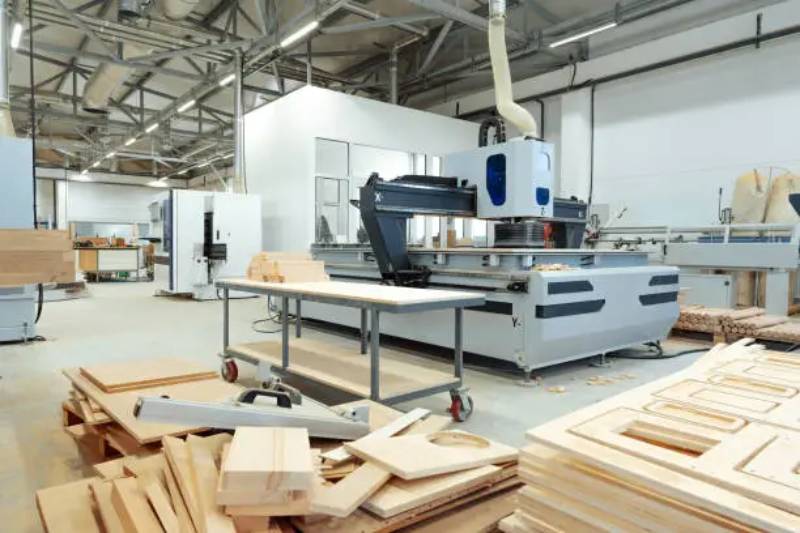
The global furniture manufacturing industry is undergoing a rapid transition toward Industry 4.0 automation. Prominent industrial clusters, such as Yecla, Spain, showcase how automated production lines are shaping local industrial manufacturing trends and accelerating output.
However, as automated machinery becomes faster and more powerful, workplace safety challenges scale exponentially. Safeguarding operators no longer relies on caution alone; primary protection now depends directly on the physical integrity of machine enclosures.
The Unique Hazards of High-Volume Woodworking Machinery
Mechanical Vibration and Component Fatigue
High-output woodworking machinery—especially high-speed CNC Routers and Edge Banders—generates constant, high-frequency vibration during continuous operation.
Over time, this mechanical oscillation causes severe structural fatigue on access doors and safety guards. Without proper isolation hardware, fasteners loosen and cabinet doors shift, exposing operators to high-speed rotating blades.
The Threat of Combustible Wood Dust
Centralized dust extraction systems are mandatory for managing fine particulates generated during cutting and sanding operations. Left uncontained, fine wood particles create a significant Combustible Dust hazard capable of fueling severe facility fires or explosions.
If access hatches or cabinet doors fail to maintain a air-tight seal, dangerous dust escapes into the working atmosphere. Ensuring localized containment requires high-grade enclosure sealing that resists vibration-induced deformation.
| Common Furniture Manufacturing Hazards | Physical Enclosure Requirements |
| High-Speed Ejected Debris & Blade Contact | Impact-resistant door panels and heavy-duty structural frames |
| High-Frequency Vibration & Structural Fatigue | Vibration-resistant hinges and self-locking mounting hardware |
| Fine Wood Dust Leakage & Explosion Risks | Precision-aligned gaskets and high-compression latching systems |
| Unintended Access During Operation | Interlocked access doors with integrated Lockout/Tagout (LOTO) compatibility |
Why Standard Equipment Hardware Fails in Heavy-Duty Environments
In high-output furniture factories, the constant vibration generated by CNC routers, edge banders, and industrial saws places immense mechanical stress on machinery panels. Standard commercial fittings degrade quickly under these conditions, leading to loose safety guards or compromised seals on centralized dust collection units. Upgrading to engineered kunlong—such as high-compression latches and vibration-resistant hinges—is essential to ensure that access panels remain tightly secured, effectively containing combustible wood dust and continuously isolating operators from high-speed moving components.
Maintaining physical structural integrity across 24/7 manufacturing schedules requires hardware engineered specifically for high vibration and mechanical stress. Using commercial-grade latches on industrial machinery compromises facility safety and leads to unscheduled operational downtime.
Engineering Controls: Isolating Workers from the Source
Precision Sealing for Dust Collection
Achieving a true air-tight seal on dust extraction access doors requires uniform pressure across the entire perimeter of the gasket.
High-compression latches apply concentrated force to compress rubber and silicone seals evenly. Coupled with load-bearing hinges, these components eliminate minor door sagging that would otherwise allow fine dust particulates to escape into the factory air.
Lockout/Tagout (LOTO) Compatibility
Routine maintenance on saw arbors and cutter heads requires strict adherence to Lockout/Tagout (LOTO) procedures to eliminate unexpected machine startup.
Safety-critical enclosure handles and latches must feature built-in padlockable Hasps. This physical design ensures maintenance personnel can directly apply safety locks to enclosure doors, preventing unauthorized access until all dangerous kinetic energy is completely discharged.
Key Takeaways
| Area | Key Takeaway | Impact/Data |
| Safety Strategy | Mandate physical enclosures over reliance on PPE | Complies with OSHA standards; isolates hazards at source |
| Dust Control | Install precision gaskets and high-compression latches | Prevents combustible dust leakage and explosion risks |
| Hardware Specs | Upgrade to engineered vibration-resistant hinges and latches | Eliminates door sag and blade exposure during 24/7 operation |
| Access Control | Integrate built-in padlockable Hasps on enclosure handles | Enforces strict LOTO compliance during machine maintenance |
The Regulatory Framework for Machine Guarding
Global occupational health guidelines emphasize engineering controls as the most effective defense against industrial machinery injuries. Physical barriers eliminate operator exposure to hazardous points of operation before an accident can occur.
Relying solely on worker training and personal protective equipment is grossly insufficient when dealing with high-speed automated cutting tools. According to the foundational machine guarding standards established by the Occupational Safety and Health Administration (OSHA), employers are strictly required to use robust physical barriers and engineering controls to secure all hazard areas. Ensuring that every enclosure door, dust collector access panel, and protective guard is heavily secured prevents unauthorized or accidental access to Nip Points and rotating blades, effectively neutralizing the risk before an operator is ever in danger.
World-class furniture manufacturing relies on more than efficient production lines and modern design. True operational excellence is founded on robust physical infrastructure and the uncompromising reliability of the safety hardware protecting the workforce.











.